
Free Tarot Trainer
Tarot Trainer: Learn All 78 Cards
Flashcards and a quiz that teach you the deck the way working readers learn it: Majors first, then one suit at a time.
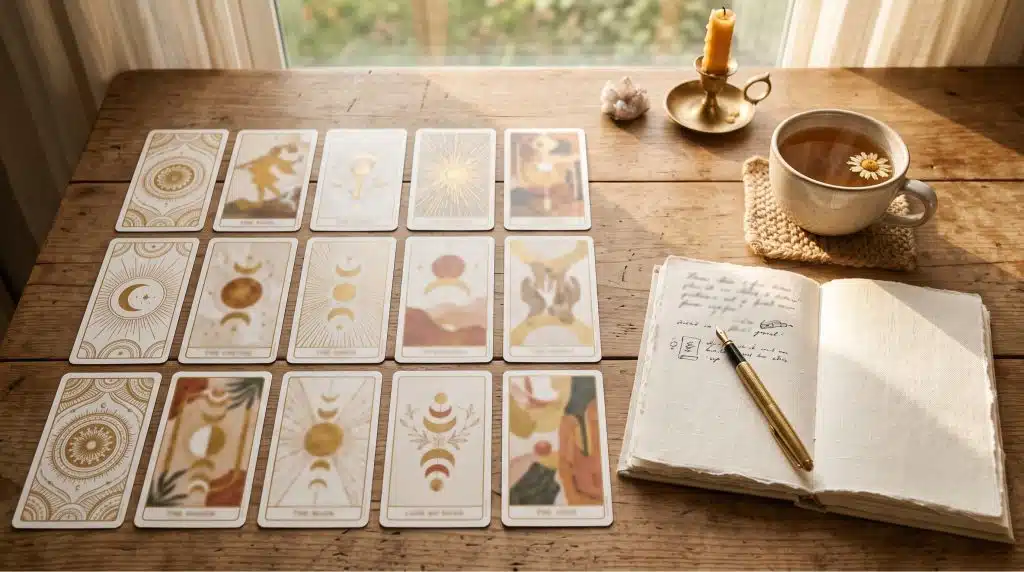
Ready to go past keywords?
The trainer teaches you recall. My guide teaches you reading: all 78 cards upright and reversed, six spreads, the 30-day plan this trainer follows, and the roadmap to reading professionally. 48 pages, instant download.
$19 USD, one time
Why trying to memorize 78 card meanings rarely works
When I first tried to learn tarot cards, I did what most people do. I opened the little white booklet, read the meanings over and over, and hoped they would stick. They did not. A week later I could tell you the Fool and the Tower and not much else. The problem was not my memory. The problem was the method. Rereading a list of 78 meanings treats every card as a random fact. Your brain has nothing to hang them on, so they slide straight off.
What works is structure first. Most of the deck follows a simple pattern. Each suit carries one element, and each number carries one stage of a story. Once you know that Cups are feelings and fives are conflict, you can work out the Five of Cups without ever having memorized it. That is loss you are still staring at. I explain the whole system on my page about tarot suits and numbers, and it cuts the real memory work down to a fraction of the deck.
The second piece is how you practice. Recall beats rereading. When you look at a card and force yourself to answer before you flip it over, your brain has to reach for the meaning. That reach is what builds the memory. Reading the answer again feels easier, but easy is exactly why it fails. You want the small struggle.
The third piece is timing. Short sessions spread across days beat one long cram. If you meet a card today, again tomorrow, and again in three days, each gap forces your brain to retrieve it just as it starts to fade. That is why ten minutes a day for a month will do more for you than a whole weekend of studying once.
How to use this trainer well
The trainer above is built around those three ideas, so here is how I would use it. Start with the Major Arcana filter switched on and nothing else. Those 22 cards carry the big themes, they are the easiest to remember because each one is so distinct, and getting them down first gives you a quick win. Spend your first week there. Then add one suit at a time, Wands, then Cups, then Swords, then Pentacles. This mirrors the 30-day plan I lay out in my full guide on how to learn tarot, so if you want the day-by-day version, it is all there.
Use the tarot flashcards first. Flip through a new group slowly and just meet the cards. Look at the image, read the meaning, notice what the picture is doing. Once the cards feel familiar, switch to the tarot quiz. Quiz mode is where the real learning happens, because now you have to recall instead of recognize.
Mark cards honestly. If you hesitated, or you half knew it, mark it as one you missed. The trainer can only bring back the cards you struggle with if you tell it the truth. Nobody is watching your score. The only person a generous mark cheats is you.
And keep sessions short. Ten minutes a day beats one long session every time. Your progress is saved in your browser on this device, so you can close the page tonight and pick up exactly where you left off tomorrow.
From recall to actual readings
Knowing what a card means is step one. Using it in a spread is the actual skill, and the trainer alone will not teach you that. So run a small practice habit alongside it. Each morning, pull one real card, or use my tarot card of the day page, and ask what it reflects about the day ahead. One card, one honest sentence. That daily rep teaches you to connect a meaning to a real situation.
Once a week, do a three-card reading on a real question. You can practice with my free three-card reading if you do not have a deck handy yet. Read the cards as a sentence, not three separate facts. And when a card stumps you mid-reading, that is normal. Look it up in my tarot card meanings library, then add it to your next trainer session. I still look cards up sometimes, and I have been reading for years.
One more thing. Tarot is not fortune-telling, and learning the cards will not make you a predictor of anything. The cards are a mirror. They give you 78 ways to look at a question, a decision, or a stuck feeling. That is what you are memorizing here, a vocabulary for reflection. It is worth the month it takes.
Questions about learning the tarot cards
How long does it take to learn all 78 cards?
For working recall, about a month of daily practice. Ten minutes a day, Major Arcana first, then one suit per week. You will not have every card word perfect in 30 days, but you will know the deck well enough to read with it, and reading is what locks it in.
Do I need to learn reversed cards too?
Not yet. Learn the upright meanings first, because every reversal is built on the upright card. Plenty of readers never use reversals at all. When you are ready, my guide on how to learn tarot covers a simple way to handle them.
Is it cheating to use flashcards instead of intuition?
No. Structure and intuition grow together. Knowing the standard meaning gives your intuition something to push against. Once the basics are automatic, you stop reaching for the booklet and start noticing what the card says to you in this reading, for this question.
Will my progress be saved?
Yes. Your progress is stored in this browser on this device, so it will be here when you come back. It will not follow you to another device or browser. The reset button clears everything if you want a fresh start.
Tarot is a tool for reflection and decision support, not fortune-telling. Explore all my free tools in the Tarot Hub.
Drilling all 78 cards?
Keep the meanings beside you while you learn. Get the printable tarot cheat sheet, free.
Free download
Get your free tarot cheat sheet PDF
Enter your details and I will send the printable PDF straight to your inbox.
Flashcards teach you what each card means. The Complete Tarot Reading Guide teaches you the part that actually matters: how the cards talk to each other in a spread, and how to trust what you see.