

A Human Design bodygraph looks confusing the first time you see one: a figure made of nine shapes, red and black lines, two columns of numbers down the sides. Give it twenty minutes with this guide and that chart turns into one of the clearest maps of your energy you will ever read. You will learn how to get your free chart, what every part of the bodygraph means, which of the five types you are, how your inner authority makes decisions, and how to use all of this for your career, relationships and spiritual growth. No experience needed, only your birth date, your exact birth time and the place you were born.

Human Design at a glance
- Founded1987, Ra Uru Hu, Ibiza
- Built fromAstrology, I Ching, Kabbalah, chakras, physics
- Types5
- Centers9 (defined or undefined)
- Gates64
- Channels36
- Profiles12
- You needBirth date, exact time, location
What is a Human Design bodygraph?
The Human Design system was received by a Canadian man named Robert Allan Krakower, later known as Ra Uru Hu, over eight days in January 1987 on the island of Ibiza. He described it as a transmission rather than an invention, and he spent the rest of his life teaching it through what became the Jovian Archive, the official home of the original teachings of Ra Uru Hu. Whether you take the origin story literally or not, the system itself is a synthesis of several older traditions laid on top of each other.
It takes the planetary positions from Western astrology. It takes the 64 hexagrams of the I Ching and turns them into the 64 gates. It takes the Tree of Life from the Kabbalah and turns its paths into the channels. It takes the Hindu chakra system and expands the seven chakras into nine energy centers. Then it wraps all of this in language borrowed from modern science, quantum physics and the neutrino stream in particular, with the idea that the neutrinos passing through you at the moment of your birth imprinted a specific pattern. Ra Uru Hu called the result the science of differentiation, because its whole point is that you are not like anybody else and you were never meant to be.
The bodygraph, also written body graph, is the chart itself. It is the map of your energetic design, the picture that holds your type, your strategy, your inner authority, your profile, your defined and undefined centers, your gates and channels and your incarnation cross. Everything else in Human Design is a reading of that one picture.
How to get your free Human Design chart
You do not need to pay anyone to see your chart. Several sites produce a free bodygraph in seconds. The two I send people to first are the Jovian Archive free chart, which is the official source, and myBodyGraph, which is the Jovian Archive’s consumer site. Genetic Matrix and several app based calculators give the same core data with a slightly different look. Enter three things.
1. Your birth date
Day, month and year. Simple, and the one piece of birth data almost everyone has.
2. Your exact birth time
This is the part that matters most and the part most people guess at. Your type is usually stable within a window of an hour or two, but your profile, your incarnation cross and sometimes your authority can change with a shift of minutes, because the Moon moves quickly and the gates it activates change. Find your birth certificate. In the United States most long form birth certificates record the time. If the certificate does not have it, ask your mother, a hospital record or a baby book. If you truly cannot find an accurate birth time, run the chart at a few different times across the day and see which parts stay the same. A Human Design reader can also do a rectification, working backwards from your life events to a likely time.
3. Your birth location
The city or town is enough. The calculator uses the location to convert your local birth time to universal time and to handle daylight saving, which is why two people born at the same clock time in different places get different charts.
Press calculate and you will see the bodygraph, plus a summary of your type, strategy, authority, profile, definition and cross. Print it or screenshot it, because you will come back to it as you read.
How to read the bodygraph: the layers in order
Beginners make one mistake above all others. They try to read every number at once and give up. Read the chart in layers, from the biggest brushstroke to the finest detail, in this order.
- Type. One of five. Sets your overall role and how your energy works.
- Strategy. How your type is designed to meet life and make decisions correctly.
- Inner authority. The part of your body you trust for major decisions.
- Profile. Two numbers, like 3/5 or 1/3, describing your character and the costume you wear in the world.
- Definition. How your defined centers connect, which shapes how you process life.
- Centers. The nine shapes, colored in when defined and white when undefined or open.
- Channels and gates. The lines between the centers and the numbers at their ends.
- Incarnation cross. The four most important gates, your life purpose theme.
Two more things to notice before we start. Down the left side of the chart is a column of red numbers. Down the right side is a column of black numbers. Black is your personality, the conscious part of you, calculated from the moment of your birth. Red is your design, the unconscious part, calculated from the position of the Sun roughly 88 degrees before your birth, which works out at about 88 to 89 days earlier. You know your black side. Other people often see your red side better than you do. Where a channel is half red and half black, it is both.
The five Human Design types
Your energy type is the first thing a calculator tells you and the most important thing to understand. It is decided by which centers are defined and how they connect to the Throat. There are five types, and each has a strategy to follow, a signature feeling that shows you are living correctly, and a not-self theme that shows you are not.
| Type | Share of people | Strategy | Signature | Not-self theme |
|---|---|---|---|---|
| Generator | About 37% | Wait to respond | Satisfaction | Frustration |
| Manifesting Generator | About 33% | Wait to respond, then inform | Satisfaction | Frustration and anger |
| Projector | About 20% | Wait for the invitation | Success | Bitterness |
| Manifestor | About 9% | Inform before you act | Peace | Anger |
| Reflector | About 1% | Wait a lunar cycle | Surprise | Disappointment |
Generator
Generators have a defined Sacral center and no motor center connected to the Throat. They are the builders of the world, with consistent energy to work on what lights them up and a sacral response that answers life with a gut yes or a gut no. The strategy is to wait to respond: instead of chasing, a Generator lets life bring options and then feels for the sacral response before saying yes. The way of the Generator is to follow that response into work that creates satisfaction. When a Generator pushes into things the sacral never agreed to, the result is frustration, the Generator’s not-self theme, and the burnt out feeling of being busy with the wrong life.
Manifesting Generator
A Manifesting Generator also has a defined Sacral, plus a motor center connected to the Throat. They respond like a Generator, then move like a Manifestor, fast and with several projects at once. They skip steps, which is a gift and a problem, because they often have to circle back and pick up what they skipped. The strategy is to wait to respond, then inform the people affected before acting. The signature is satisfaction, the not-self theme is frustration mixed with anger.
Projector
Projectors have no defined Sacral and no motor to the Throat. They are not here to do the heavy lifting. They are here to see others clearly and to guide, manage and advise. Because their energy is not consistent, they work best in bursts and need more rest than the Generators around them. The strategy is to wait for the invitation for the big things in life: a job, a relationship, a home, a chance to share their insight. Uninvited advice from a Projector lands badly no matter how right it is. The signature is success, the not-self theme is bitterness.
Manifestor
Manifestors have a motor center connected to the Throat and no defined Sacral. They are the only type designed to initiate. They have a strong impact on others and a deep need for freedom, and people often feel their aura before they say a word. The strategy is to inform before acting, not to ask permission, which Manifestors hate, but to tell the people affected what they are about to do so that resistance drops. The signature is peace, the not-self theme is anger.
Reflector
Reflectors have no defined centers at all. They are the rarest type, around one in a hundred people, and they are a mirror for the people and places around them. A Reflector’s experience of life changes with the environment, which makes the right environment the most important decision of their lives. The strategy is to wait a full lunar cycle, about 28 days, before any major decision, because the Moon moving through the gates gives a Reflector a kind of borrowed consistency. The signature is surprise, the not-self theme is disappointment.
The nine energy centers
The nine shapes on the bodygraph are the energy centers. Seven of them map loosely onto the chakras you may already know, with the Solar Plexus split into two and the Throat and Ajna separated from the Head. If you want the chakra side of this, my guide to finding your blocked chakra is the companion piece.
Each center is either defined, which means colored in, or undefined, which means white. A defined center is a consistent, reliable part of you. It works the same way every day and you broadcast its energy to others. An undefined center is where you take in and amplify the energy of the people around you. It is not weak and it is not broken. It is where you learn, where you are wise about others, and also where you get conditioned into behaving like somebody you are not. Most of the not-self urgings in Human Design come from undefined centers trying to be defined. Centers with no gates activated at all are called completely open centers and have the strongest conditioning.
Head center
A pressure center at the top of the chart. Inspiration, questions, the pressure to make sense of things. Defined: you have a consistent way of being inspired and you inspire others. Undefined: you pick up everyone’s questions and feel pressure to answer them. Not-self theme: trying to answer questions that are not yours.
Ajna center
An awareness center. Thinking, concepts, opinions, how you process information. Defined: a fixed way of thinking and a reliable mind. Undefined: a flexible mind that can see from many angles and is open to any idea. Not-self theme: pretending to be certain when you are not.
Throat center
The center of manifestation and communication. Everything in the chart is trying to reach the Throat to be expressed as speech or action. Defined: a consistent voice and way of expressing yourself. Undefined: your voice changes with the company and you may talk to get attention. Not-self theme: trying to attract attention.
G center
Also called the Identity center. Love, direction, your sense of self. Defined: a fixed sense of who you are and where you are going. Undefined: your identity shifts with people and places, and the right place becomes essential. Not-self theme: searching for love and direction in the wrong places.
Heart center
Also called the Ego or Will center. A small motor. Willpower, self worth, promises, the material world. Defined: reliable willpower, and you need to make and keep promises. Undefined: willpower comes and goes, and you should not promise more than you can deliver. Not-self theme: trying to prove yourself.
Sacral center
The life force motor and the most important center for Generators and Manifesting Generators. Work energy, sexuality, the gut response. Defined: consistent energy that needs to be used every day or you will not sleep. Undefined: no consistent work energy, which is normal for Projectors, Manifestors and Reflectors. Not-self theme: not knowing when enough is enough.
Solar Plexus center
The emotional motor and awareness center. Emotions, feelings, the wave. Defined: you have an emotional wave that rises and falls, and no clarity in the moment. Undefined: you absorb and amplify other people’s emotions and may avoid confrontation to keep the peace. Not-self theme: avoiding truth and confrontation.
Spleen center
The oldest awareness center. Intuition, the immune system, survival instincts, fear, time. Defined: a reliable in the moment intuition and a steady sense of wellbeing. Undefined: you can sense what is unhealthy in others and tend to hold on to things, people and jobs past their time. Not-self theme: holding on to what is not good for you.
Root center
A pressure center and a motor. Stress, adrenaline, the drive to get things done. Defined: a consistent relationship with pressure and your own pace. Undefined: you take in other people’s pressure and hurry to be free of it. Not-self theme: rushing to get rid of pressure.
Count your defined centers. Most people have between two and six. Each one you have is a place you can rely on. Each white one is a place to be wise rather than a place to fix.
Inner authority: how you are designed to decide
If type is the most important thing in your chart, inner authority is the most useful. Human Design says the mind is a brilliant tool for processing information and a terrible tool for making major decisions. Your authority is the part of your body that knows, and it is decided by which centers are defined, in a fixed order of priority.
Emotional authority
Defined Solar Plexus. About half of all people. You have an emotional wave, and there is no truth in the now for you. Never decide in the high or the low. Sleep on it, ride the wave, and watch whether the yes stays a yes across several days. Clarity comes with time, not with thinking.
Sacral authority
Defined Sacral, undefined Solar Plexus. Generators and Manifesting Generators. Your gut answers in the moment with a sound or a sensation, an uh-huh for yes and an un-un for no, when someone asks you a yes or no question. Have a friend ask you questions out loud and listen to your body before your mind gets a vote.
Splenic authority
Defined Spleen, undefined Sacral and Solar Plexus. A quiet, instant, once only intuition. It speaks softly in the moment and does not repeat itself, so splenic people have to practice trusting the first hit and acting before the mind argues.
Ego authority
Defined Heart connected to the Throat or the G center, with no Sacral, Spleen or Solar Plexus defined. Rare. The question is what do I want, and the answer comes from willpower and self interest. Say what you want out loud and notice whether you have the will to back it.
Self-projected authority
Defined G center connected to the Throat, with none of the centers above defined. Projectors only. You find your truth by hearing yourself talk. Speak to people you trust, not for advice, but to hear what comes out of your own mouth.
Mental authority
Also called environmental or no inner authority. Projectors with nothing defined below the Throat. Decisions come from talking things through with the right people in the right environment, over time, and noticing how your body feels in each place.
Lunar authority
Reflectors. With no defined centers there is nothing inside to rely on, so a Reflector waits through a full lunar cycle, talks to trusted people along the way, and decides once the Moon has shown them every angle.
Your profile: the two lines
Your profile is the pair of numbers written like 1/3 or 6/2. The first number comes from the line of your conscious Sun, the second from the line of your unconscious Sun. There are six lines and twelve possible profiles, and together they describe the character you came to play. The first number is how you see yourself. The second is how others experience you.
- Line 1, the Investigator. Needs a solid foundation of knowledge before feeling safe. Studies everything.
- Line 2, the Hermit. Natural talent that others see before you do. Needs alone time and gets called out of it.
- Line 3, the Martyr. Learns by trial and error. Nothing is a failure, it is data. Bonds are made and broken.
- Line 4, the Opportunist. Everything comes through the network. Friendship first, then opportunity.
- Line 5, the Heretic. Projected upon as a savior. Practical solutions, and a reputation that needs managing.
- Line 6, the Role Model. Three life phases: trial and error until about 30, retreat on the roof until about 50, then wise example.
The twelve profiles are 1/3, 1/4, 2/4, 2/5, 3/5, 3/6, 4/6, 4/1, 5/1, 5/2, 6/2 and 6/3. A 3/5, for example, learns through experience and is seen by others as the person with the answers, which can be a heavy combination until they stop apologizing for their mistakes. A 1/3 needs to research before leaping and then leaps anyway, and that is correct for them.
Definition: how your centers connect
Definition describes whether your defined centers are all connected to each other through channels or sit in separate groups.
- Single definition. All defined centers connect in one continuous circuit. You process life as a whole and are self contained. Around 40 percent of people.
- Split definition. Two separate groups. You feel a gap in yourself and are drawn to people who bridge it. Around 45 percent.
- Triple split. Three groups. You need varied people and environments to feel complete and take longer to make decisions.
- Quadruple split. Four groups. Rare. Fixed and reliable, and the slowest to process.
- No definition. Reflectors, with no defined centers.
If you have a split, the gates that would bridge it are called bridging gates. People who carry them feel oddly familiar to you and relationships with them can feel like coming home, which is useful to know before you mistake that for destiny.
Gates and channels
The small numbers on the bodygraph are the gates. There are 64, one for each hexagram of the I Ching, and each sits at the edge of a center. A gate is activated when a planet occupied it at your birth or at your design date, and it is colored black, red or both. A gate on its own is a hanging gate, a potential that looks for its other half in other people.
When both gates at the two ends of a line are activated, the line between them is colored in and becomes a channel. There are 36 channels, and a channel is what defines the two centers at its ends. This is why definition travels: one channel can light up two centers and change your whole type. Each channel has a name and a theme. Channel 34-20, the Channel of Charisma, joins the Sacral to the Throat and makes a Manifesting Generator. Channel 1-8, the Channel of Inspiration, joins the G center to the Throat and gives a creative role model. You do not need to learn all 36 at first. Learn the ones you have, because each one is a consistent, lifelong theme in you.
The incarnation cross: your life purpose theme
At the bottom of most chart summaries you will see something like Right Angle Cross of the Sphinx or Left Angle Cross of Revolution. This is your incarnation cross, and it is built from the four most important gates in your chart: your conscious Sun and Earth, and your unconscious Sun and Earth. Those four gates hold around 70 percent of the energy of the whole design, which is why the cross is read as the theme of your life purpose.
There are three kinds. Right Angle crosses, the most common, carry a personal destiny: your life is about your own process and you are not required to carry others. Left Angle crosses carry transpersonal karma: your purpose unfolds through the people you meet and the effect you have on them. Juxtaposition crosses are rare and carry a fixed fate, a specific theme that plays out no matter what. The cross is not something you do. It is what happens through you when you live by your strategy and authority, and most people only start to see theirs clearly after the first Saturn return around age 29 or 30.
Human Design and your astrology birth chart
People often ask me whether they should read their Human Design or their astrology birth chart. Read both, because they use the same birth data and answer different questions. The bodygraph tells you how your energy works and how to make decisions. The birth chart tells you who you are, what you need, where your gifts and wounds sit and what the planets are activating in your life right now. Human Design does not do timing beyond the lunar cycle. Astrology does little else.
If you only have birth data for one reading, start with the one that matches the question. Burnt out, stuck in the wrong job, saying yes to everything? Human Design. Want to understand your personality, your relationships, your purpose and the timing of a big change? Astrology. If you are new to the planets, Astrology 101 walks you through your own chart in plain language, and the life path number from numerology adds a third layer from the same birth date.
Want your birth chart read for you?
Your exact birth time already gives you a Human Design chart. The same time gives you a full natal chart. I read your Sun, Moon, rising, the houses and the current transits and put it in plain language: strengths, challenges, purpose, and what is being activated in your life right now.
Book a Birth Chart ReadingHow to use your bodygraph in real life
For decisions
Pick one decision this week and run it through your strategy and authority instead of your mind. A Generator waits for something to respond to and listens to the gut. An emotional authority sleeps on it three nights. A Projector notices whether they were invited. Keep a note of how it goes. Human Design calls this the experiment, and seven years of it is said to recondition the body.
For career
Generators and Manifesting Generators need work their sacral says yes to and will suffer in any job that does not use their energy. Projectors do best in roles where they guide, manage, teach or advise, and in shorter, deeper working days. Manifestors need autonomy and do badly under micromanagement. Reflectors need the right workplace environment above the right job title. Your profile adds detail: a line 4 builds a career through the network, a line 1 through expertise, a line 5 through solving problems for others. If you are a spiritual entrepreneur, this is also the fastest way to understand why some marketing advice drains you: it was written by a Manifestor and you are a Projector.
For relationships
Relationship charts, also called composite or connection charts, lay two bodygraphs over each other. Where one person defines a center the other has open, there is attraction and conditioning. Where both have the same center open, there is understanding and a shared blind spot. Electromagnetic channels, where you each carry one gate of the same channel, create chemistry. None of this says whether a relationship is good. It says what it will feel like and where to be careful.
For spiritual growth
The deepest use of the chart is deconditioning: noticing where your undefined centers have taught you to be someone else, and slowly putting that down. Most of the suffering people bring to a reading sits in one of their open centers. Finding it on the chart turns a vague feeling of being wrong into a specific pattern you can watch for, which is the beginning of living as your true self.
Five beginner mistakes
- Reading the chart as a personality test. It is a decision making system first. Type and authority matter more than any gate.
- Treating undefined centers as flaws. They are where you take in the world and where your wisdom about others lives.
- Using a guessed birth time. Check your profile at a few times across the day before you build your identity around a 5/1.
- Skipping strategy. People learn their incarnation cross and still decide with their mind. Start with the basics and live them.
- Using type as an excuse. Projectors still work. Manifestors still inform. Reflectors still decide. The chart explains how, not whether.
A reality check. Human Design has no scientific evidence behind it, and the physics language in its story is poetic rather than literal. Treat the chart the way I treat astrology and tarot: as a mirror and a language for self reflection, not a diagnosis. If something in your chart does not match your lived experience, your experience wins.
Frequently asked questions
What is a Human Design bodygraph?
The bodygraph is the chart used in the Human Design system. It shows nine energy centers, 64 gates and 36 channels calculated from your birth date, exact birth time and birth location, and it reveals your type, strategy, inner authority, profile, definition and incarnation cross.
How do I get my free Human Design chart?
Enter your birth date, exact birth time and birth city into a free calculator such as the Jovian Archive or myBodyGraph site. The chart generates in seconds and shows your type, strategy, authority and profile.
Do I need my exact birth time for Human Design?
Yes, as exact as possible. Type is fairly stable across an hour or two, but your profile, incarnation cross and sometimes your authority change with minutes. Check your birth certificate or run the chart at several times to see what stays constant.
What are the five Human Design types?
Generator, Manifesting Generator, Projector, Manifestor and Reflector. Generators and Manifesting Generators make up about 70 percent of people, Projectors about 20 percent, Manifestors about 9 percent and Reflectors about 1 percent.
What does a defined center mean in Human Design?
A defined center is colored in on the bodygraph and represents a consistent, reliable energy in you that you broadcast to others. An undefined or white center is where you take in and amplify the energy of people around you, and where you are most open to conditioning.
What is the rarest Human Design type?
The Reflector, with no defined centers, is the rarest at around one percent of people. Manifestors are the second rarest at around nine percent.
What is the difference between Human Design and astrology?
Both use your birth date, time and place. Astrology reads the planets in signs and houses to describe your personality, needs and timing. Human Design maps the same planetary positions onto the I Ching gates and nine centers to describe how your energy works and how you should make decisions.
Is Human Design scientifically proven?
No. The system borrows language from quantum physics and neutrino science, but there is no scientific evidence for its claims. Most people use it as a tool for self reflection and better decision making rather than as a science.
Learn the planets behind your chart
Every gate in your bodygraph is a planet in a sign. Astrology 101 teaches you to read your Sun, Moon, rising sign and houses yourself, in plain English, and shows you where to go next.
Read Astrology 101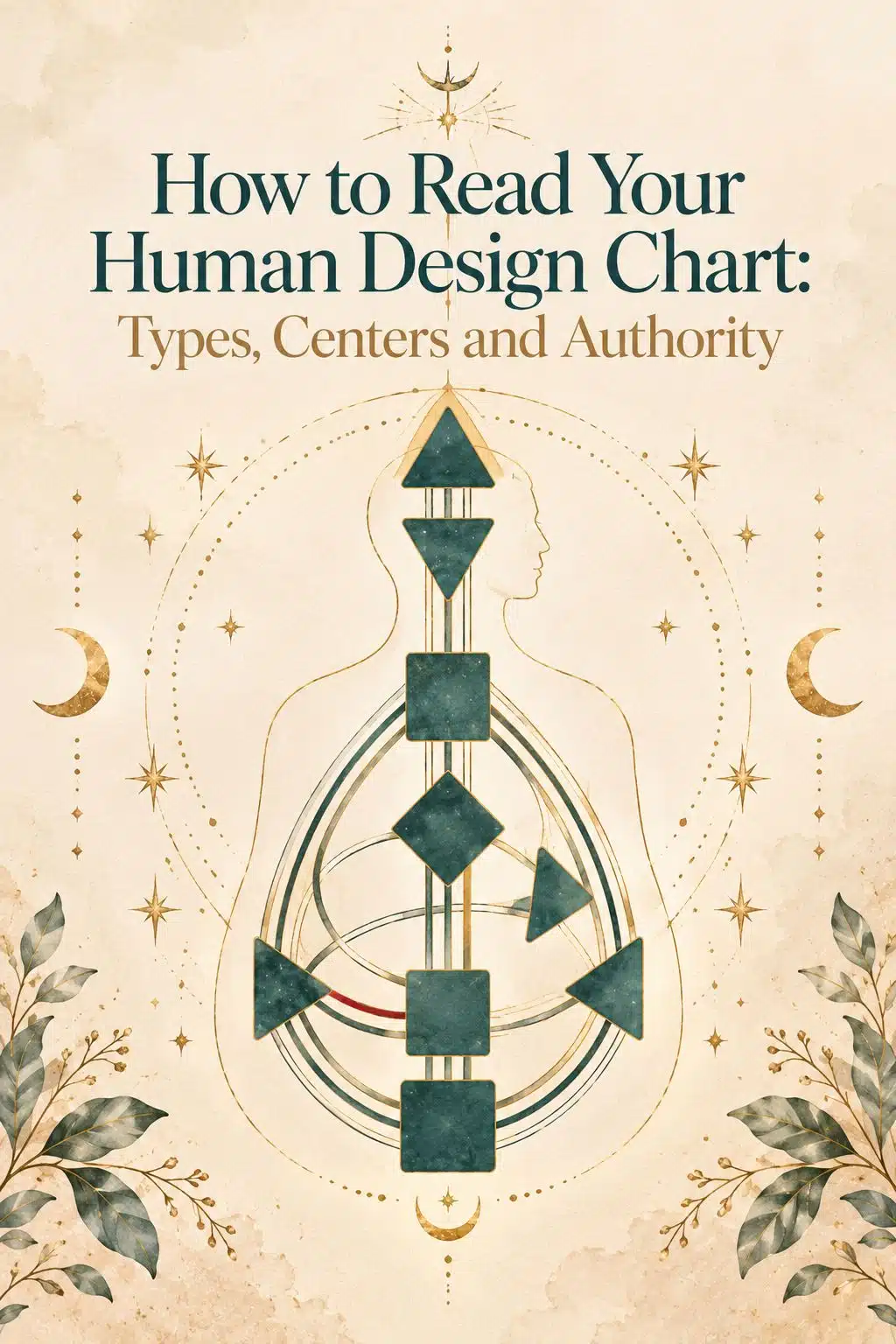
love, light and blessings,
Namaste Sunny
Make Blissful Careers a preferred source on Google
One click tells Google to show you more of my articles when you search. You can change it back any time.
Opens Google in a new tab. Tick the box next to Blissful Careers and you are done.